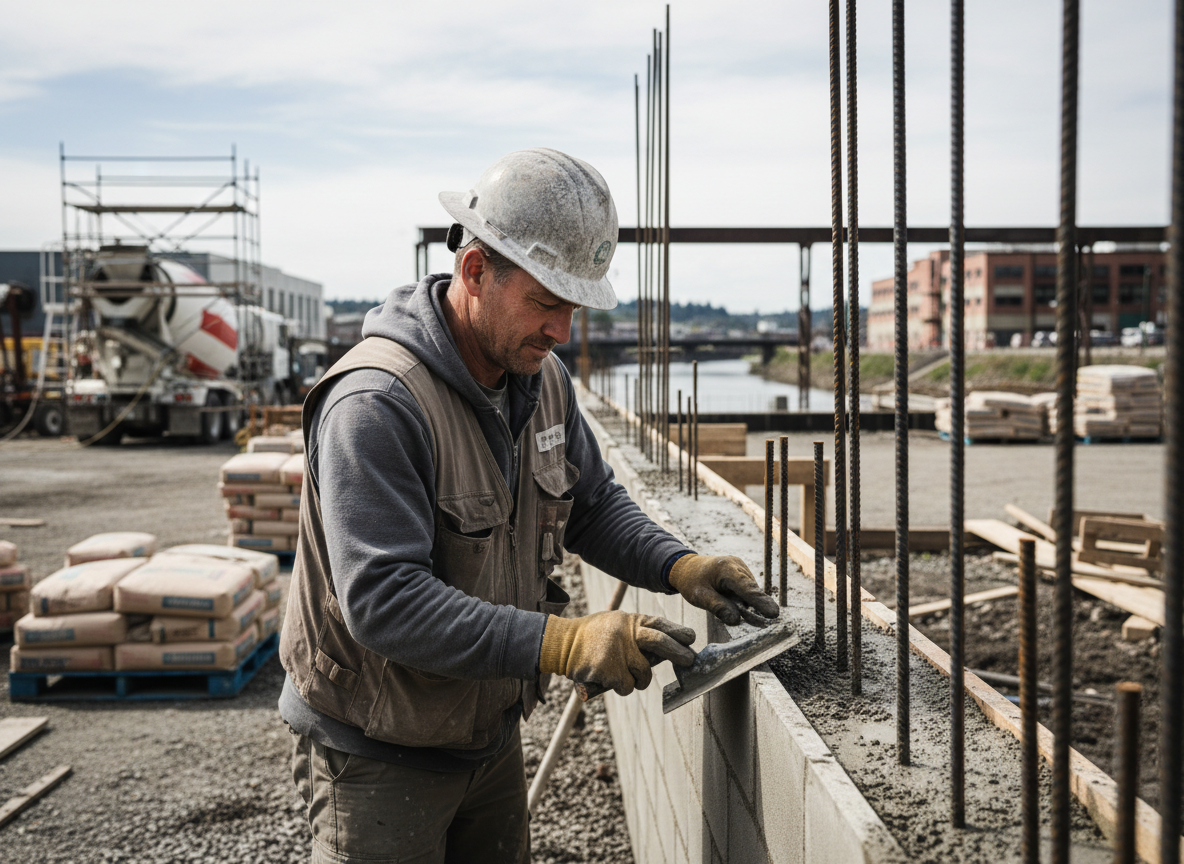
Concrete masonry in Milwaukie must account for the county's mild wet winters that saturate clay-heavy soils along the Willamette River. Homes in Island Station and Ardenwald often sit on older footings that shift when prolonged rain raises the water table. Proper base preparation with compacted gravel and perimeter drainage prevents the cracking that appears every spring. We use fiber-reinforced mixes and integral waterproofing additives rather than surface sealers that fail after a few freeze-thaw cycles.
Downtown Milwaukie and Hector Campbell neighborhoods contain many mid-century homes with original block foundations now showing spalling from constant ground moisture. When replacing or parging these walls we excavate to the footing, install dimple mat, and tie new concrete to the existing structure with stainless steel pins. This approach handles the expansion that occurs when warm dry summers follow the wet season and soil shrinks. Skipping the drainage step is the most common reason repairs fail within five years here.
Retaining walls near Milwaukie Riverfront Park must resist both river-adjacent saturation and the surcharge from sloped yards common in Clackamas County. We form and pour walls with keyways and weep holes sized for local rainfall volumes, then backfill with free-draining rock rather than native soil. This detail keeps hydrostatic pressure off the concrete during the long wet months and prevents the leaning that homeowners notice after heavy November rains.
Portland's influence brings stricter seismic requirements into Milwaukie projects even for non-structural masonry. We reinforce concrete piers and walls with rebar sized for the region's moderate earthquake risk and use expansion joints that accommodate both thermal movement from summer heat and minor settlement from riverbank soils. Homeowners who skip engineering review on larger pours often face rework when inspectors flag missing reinforcement.
Technician insight
In Milwaukie, the thing that catches most people out with concrete masonry contractor is the high water table near the Willamette River in Island Station and Ardenwald. Homeowners assume a standard pour will hold, but without dimple mat and properly sloped drains the first wet winter pushes moisture through the wall and cracks the new concrete within two seasons.
Retaining Wall Replacement in Ardenwald
A leaning block wall behind a Hector Campbell home was failing after years of winter saturation. Excavation revealed no drainage and saturated clay pushing against the blocks. We installed a new reinforced concrete wall with weep holes and free-draining backfill tied into the existing yard slope. The wall has remained plumb through two wet winters.
How it works
- 1
Site Assessment
We visit the property in Milwaukie to evaluate soil conditions, drainage, and existing masonry near the Willamette River or local neighborhoods.
- 2
Plan and Material Selection
Detailed scope and mix design are prepared using fiber-reinforced concrete and drainage details suited to Clackamas County wet winters.
- 3
Excavation and Base Work
Footings are exposed, gravel bases compacted, and perimeter drains installed to manage the high water table common along Island Station and Ardenwald.
- 4
Forming, Pouring and Finishing
Forms are set with proper reinforcement, concrete is placed, and surfaces finished for durability through summer dry periods and winter saturation.
- 5
Backfill and Final Drainage
Walls are backfilled with free-draining material and connected to existing stormwater systems before site restoration.
Pricing
Upfront quotes after site visit; cost driven by excavation depth, drainage needs, and wall height.