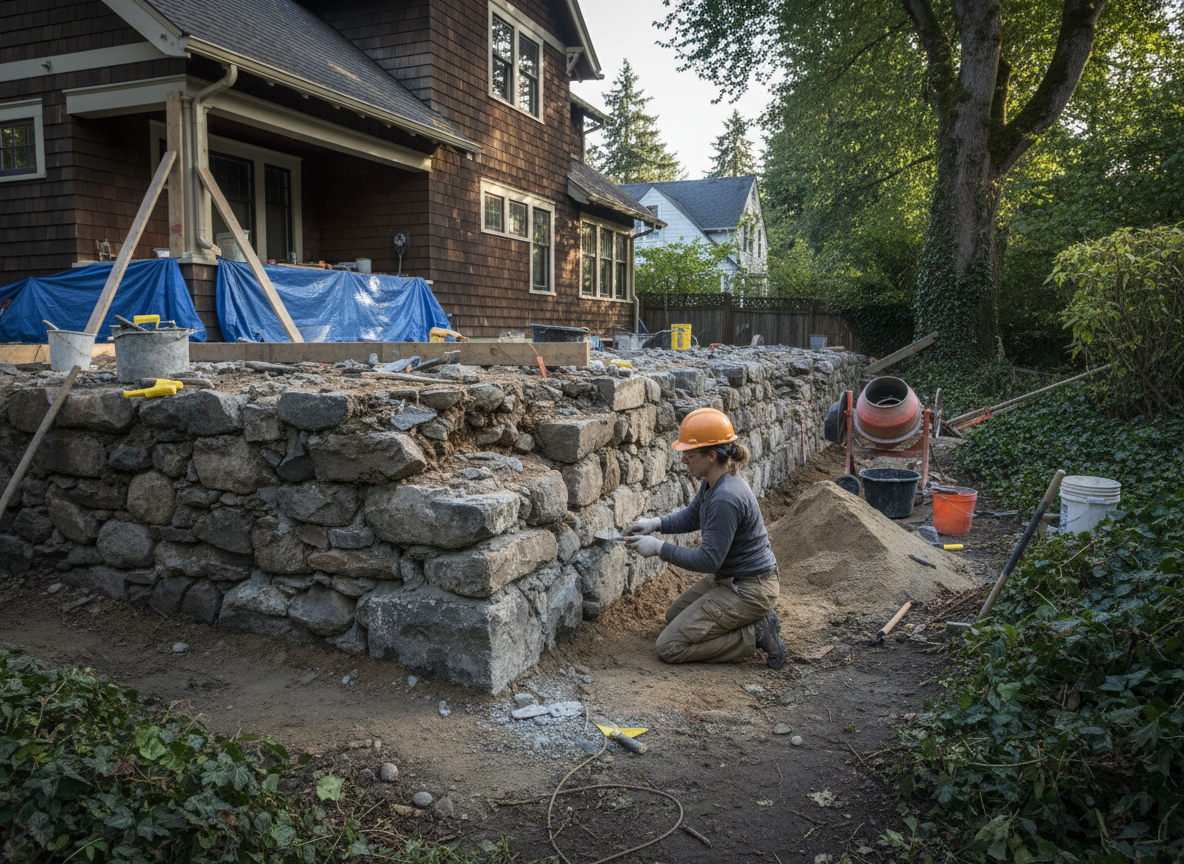
Stone foundations in Milwaukie neighborhoods like Ardenwald and Island Station often date back to the early 1900s and sit on clay-heavy soils common in Clackamas County. These foundations shift when winter rains saturate the ground, causing mortar joints to crack and stones to settle unevenly. Warm dry summers then pull moisture from the soil, widening gaps that allow water to enter during the next wet season. Matching original stone and mortar requires sourcing compatible materials that handle repeated freeze-thaw cycles without rapid deterioration.
Homes near Milwaukie Riverfront Park and along the Willamette River face additional hydrostatic pressure from seasonal river levels. Water pools against foundation walls during prolonged winter rains, pushing through any existing voids in the stonework. Proper repair involves excavating to the footing where possible, installing drainage improvements, and repointing with lime-based mortars that allow the wall to breathe rather than trap moisture. Skipping drainage upgrades in this climate almost guarantees recurring leaks within a few winters.
Downtown Milwaukie and Hector Campbell properties frequently show settlement along the front wall where original grading directs roof runoff straight at the foundation. Stone repair here starts with correcting grade and adding French drains before any masonry work begins. Attempting to patch visible cracks without fixing water flow leads to the same stones loosening again after the next heavy rain event.
Masonry contractors working in Milwaukie must also watch for older additions built on mismatched footings. Where a 1920s stone foundation meets a later concrete section, differential movement creates diagonal cracks that widen every winter. Repair requires tying the two sections together with helical ties or rebuilding the transition area so the stonework can move as a single unit.
Technician insight
In Milwaukie, the thing that catches most people out with stone foundation repair is the clay soil in Clackamas County that swells during our long wet winters and then shrinks in summer. Homeowners often point only the visible cracks without fixing how roof water runs straight at the wall in places like Ardenwald. That single step changes whether the repair lasts or fails again the next January.
Ardenwald Stone Foundation Settlement
Water was entering a 1920s stone foundation along the east wall after heavy winter rains. Excavation revealed the original grade sloped toward the house and clay soil had pushed several stones inward. We corrected drainage, repointed the wall with lime mortar, and reset the displaced stones. The basement stayed dry through the following winter.
How it works
- 1
Site Assessment
Inspect the full perimeter, check for water intrusion points, and evaluate soil conditions around the foundation in the specific Milwaukie neighborhood.
- 2
Drainage Correction
Improve grading and install drainage to move water away from the stone wall before any repair work begins.
- 3
Mortar and Stone Repair
Remove deteriorated mortar, replace damaged stones, and repoint with compatible lime mortar suited to local wet winters.
- 4
Final Grading and Protection
Restore grade around the foundation and apply breathable sealer where appropriate for the stone type.
Pricing
Upfront quotes provided after on-site inspection; cost varies with access, extent of drainage work needed, and stone matching requirements.